Begin with the section
Imagine a line drawn through a hillside, a wall and a cheese shelf. Each layer changes how heat and moisture move. Earth cover can reduce exposure to short-term weather changes. Thick masonry can absorb and release heat slowly. The room, however, still receives warmth from people, lighting, equipment and newly arrived cheese. Calling a cellar “naturally cool” describes an advantage, not a complete operating system.
Traditional rooms also differ greatly. A vaulted stone chamber, an adapted fort and a modern insulated maturation hall may all support skilled affinage. Their appearance does not establish their performance. Ask how the space is monitored, how seasonal changes are managed and which cheeses it was designed to accommodate.
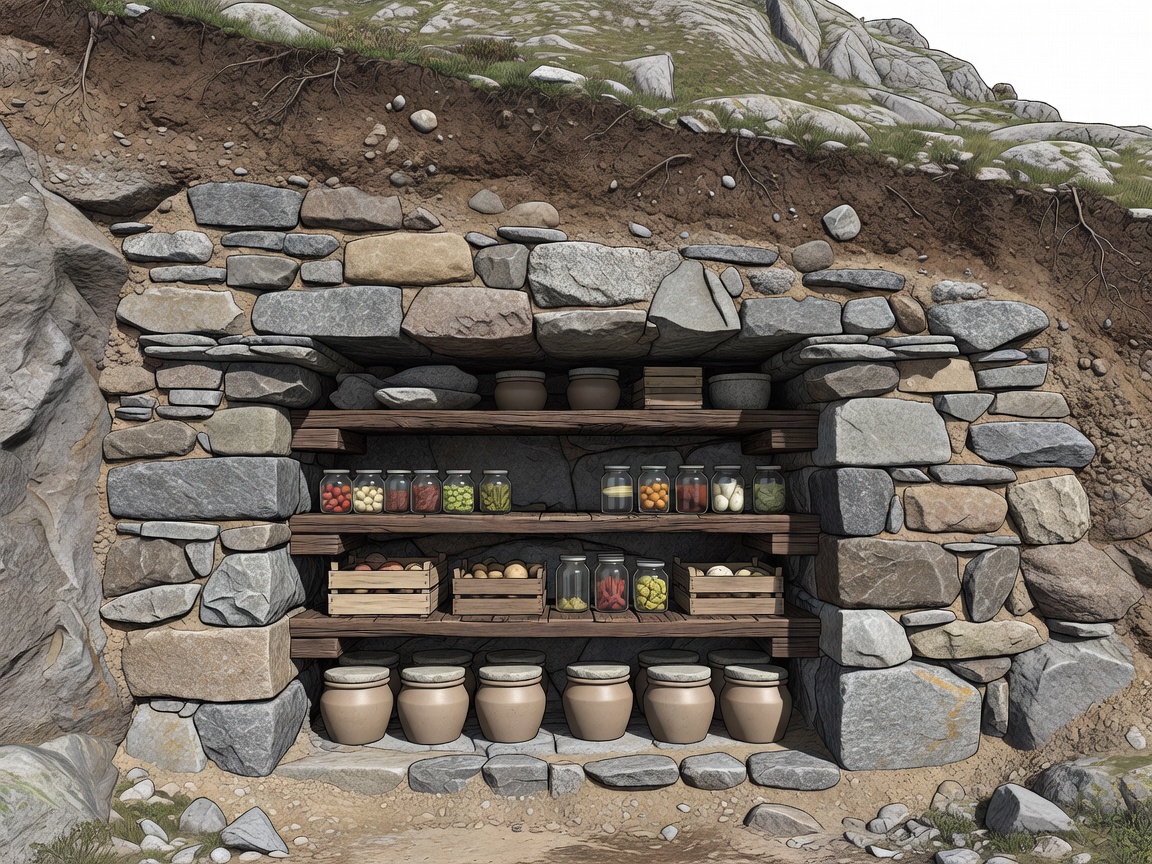
Stone buffers; it does not decide
Thermal mass is useful when it slows unwanted fluctuations. Its effect depends on the thickness and composition of the structure, its contact with the ground and the pattern of heat entering the room. A heavy wall exposed to prolonged summer warmth can eventually become warm itself. Insulation and thermal mass are different tools, even when both appear in the same building.
Geology matters first as a physical context: the shape of a slope, the availability of building stone, drainage and groundwater. It is much less defensible to say that the mineral character of a wall simply passes into a cheese. Flavour develops through milk composition, cheesemaking, salt, microbial activity and maturation conditions. A romantic explanation should not replace those mechanisms.
Moisture is a relationship
Relative humidity expresses the moisture in air in relation to what that air could hold at its current temperature. It is therefore inseparable from temperature. A cooler surface can encourage condensation even when the room seems comfortable to a visitor. Wet stone is not automatically evidence of a well-run cellar; persistent condensation may require investigation and corrective action.
Cheese also exchanges moisture with its surroundings. Excessive drying can contribute to unwanted rind development or cracking, while overly wet conditions can create other difficulties. The appropriate balance depends on the cheese, its stage of maturation and the producer's process. There is no single temperature-and-humidity pair that this guide can responsibly prescribe for every mountain cheese.
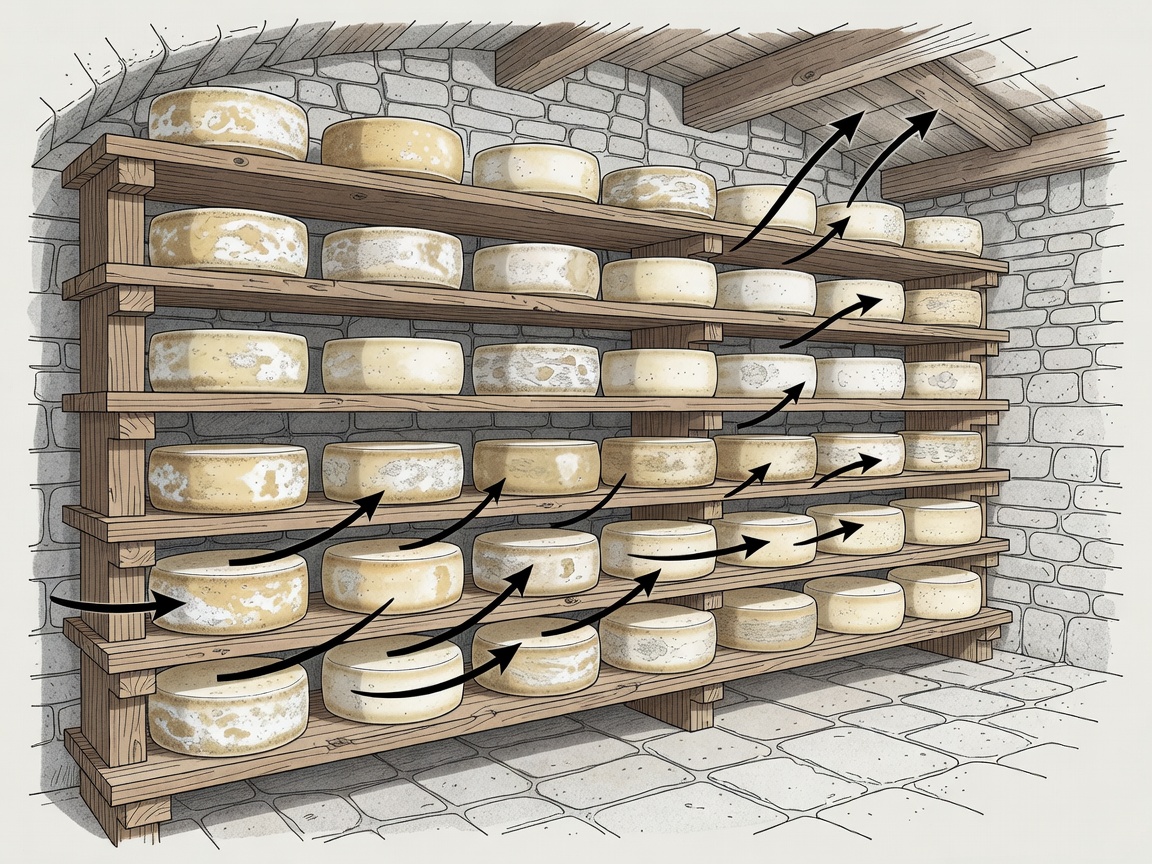
Give the air a route
Ventilation exchanges air; air circulation moves it within the room. These are related but distinct functions. A draught striking one row of wheels can dry those surfaces differently from sheltered wheels nearby. Openings, fans, shelf spacing and room geometry all influence the local environment experienced by the rind.
Outside air is not always beneficial simply because it is mountain air. Its temperature and moisture content change with weather and season. Opening a door may introduce warmth, moisture or contaminants as well as fresh air. Skilled management considers when air exchange helps and when a controlled system is more reliable.
The shelf is part of the architecture
Rack depth, aisle width and working height affect more than storage capacity. They determine whether staff can inspect, turn and handle wheels without awkward movement. Access for cleaning, separation of tasks and the movement of incoming and outgoing cheese belong in the same design conversation as the vault itself. A dramatic room with inaccessible shelves is not an especially useful maturation room.
Wooden boards appear in several established cheese traditions, but their use is tied to specific production systems and hygiene controls. Neither wood nor an alternative material should be praised in isolation from its condition, maintenance and regulatory context. Food businesses must follow applicable requirements, including the European hygiene framework where relevant; Regulation (EC) No 852/2004 is a useful starting reference rather than a substitute for local advice.
Look beyond the picturesque
The Jura's Fort des Rousses illustrates how an existing military structure can be associated with specialist cheese maturation. It should not be treated as a blueprint for every cellar. Likewise, the surroundings described by Comté and Gruyère producers reveal particular working systems, not universal rules for all underground rooms. A good visit asks what the building makes possible and what the people must still do.
The most useful architectural luxury is continuity: a room that supports careful work through changing seasons. Stable routines, sensible access and informed monitoring matter more than the romance of a damp wall. Continue with the work of affinage to see how that environment becomes a daily practice.
Reference notebook
- Comté interprofessional information — production and maturation context.
- Le Gruyère AOP — an official regional reference.
- Regulation (EC) No 852/2004 — food hygiene framework.