Not storage, but stewardship
Affinage is the maturation and care of cheese after its initial manufacture. Its exact boundaries vary between businesses: some makers mature their own cheeses, while specialist affineurs receive wheels from several dairies. In either arrangement, the task is not simply to keep stock until a date arrives. It is to help each cheese develop within its intended style.
The starting material places limits on what the cellar can achieve. Milk composition, acidification, curd handling, pressing and salting have already influenced the wheel. A skilled affineur works with those characteristics. A prestigious room cannot reliably repair every manufacturing problem, and a longer stay is not automatically an improvement.
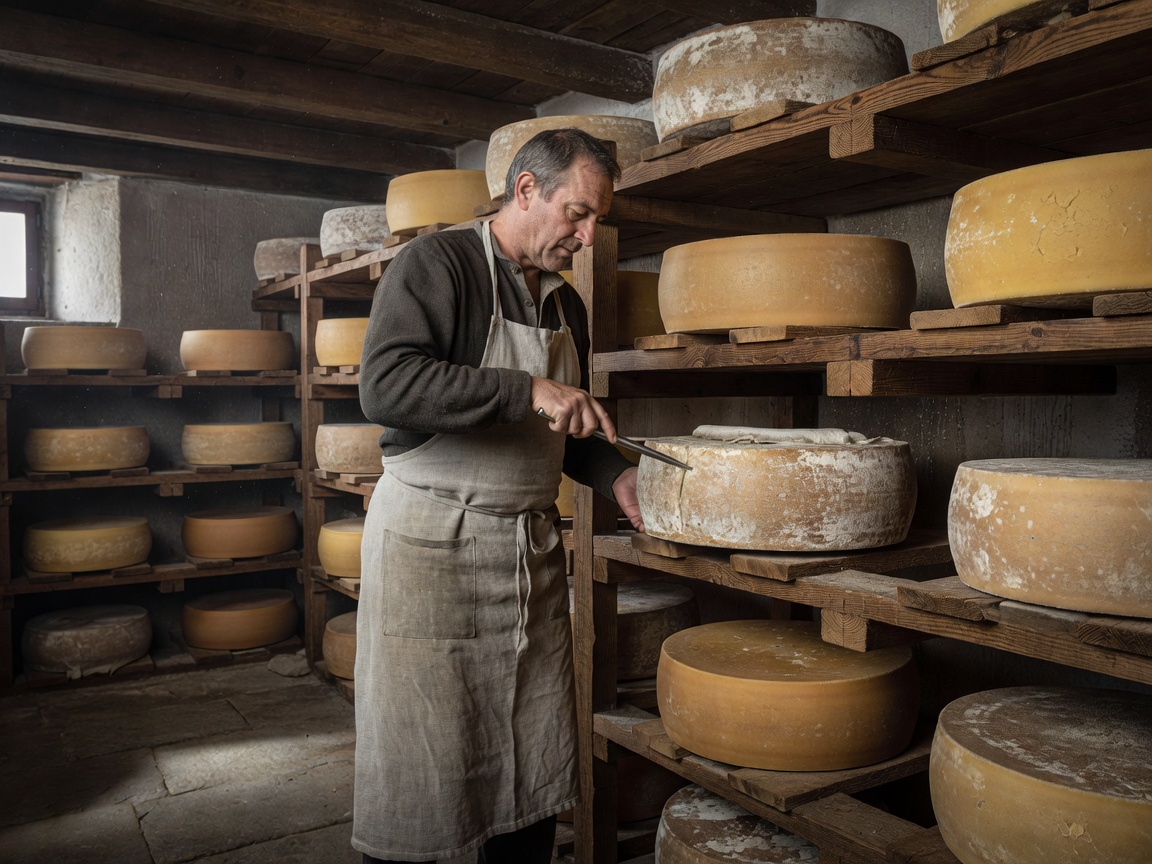
A changing interior
During maturation, enzymes break down components of the cheese, including proteins and fats. These processes contribute to changes in texture, aroma and taste. Microorganisms involved in production or rind development can influence that progression, while moisture and salt distribution also matter. Different styles follow different pathways; not every wheel becomes softer, stronger or more desirable at the same rate.
A large cooked, pressed cheese and a smaller washed-rind cheese do not share one universal schedule. Even within a named style, variation between batches can require attention. The useful question is not “How old is it?” alone, but “How has this particular cheese developed, and what is the intended eating character?”
Read before intervening
An inspection can include the appearance and feel of the rind, the condition of the shelf, signs of moisture imbalance and the wheel's handling history. Experienced professionals may use additional assessment methods appropriate to their cheese and quality system. Visitors should not assume that touching, tapping or sampling a wheel is permitted merely because they have seen a producer do it.
Records connect observations to action. A note about a dry area, an altered care routine or movement to another part of a room can explain later differences more usefully than a general claim that “the cellar did it”. This is where environmental control and craft meet: repeatable work leaves room for judgement without relying entirely on memory.
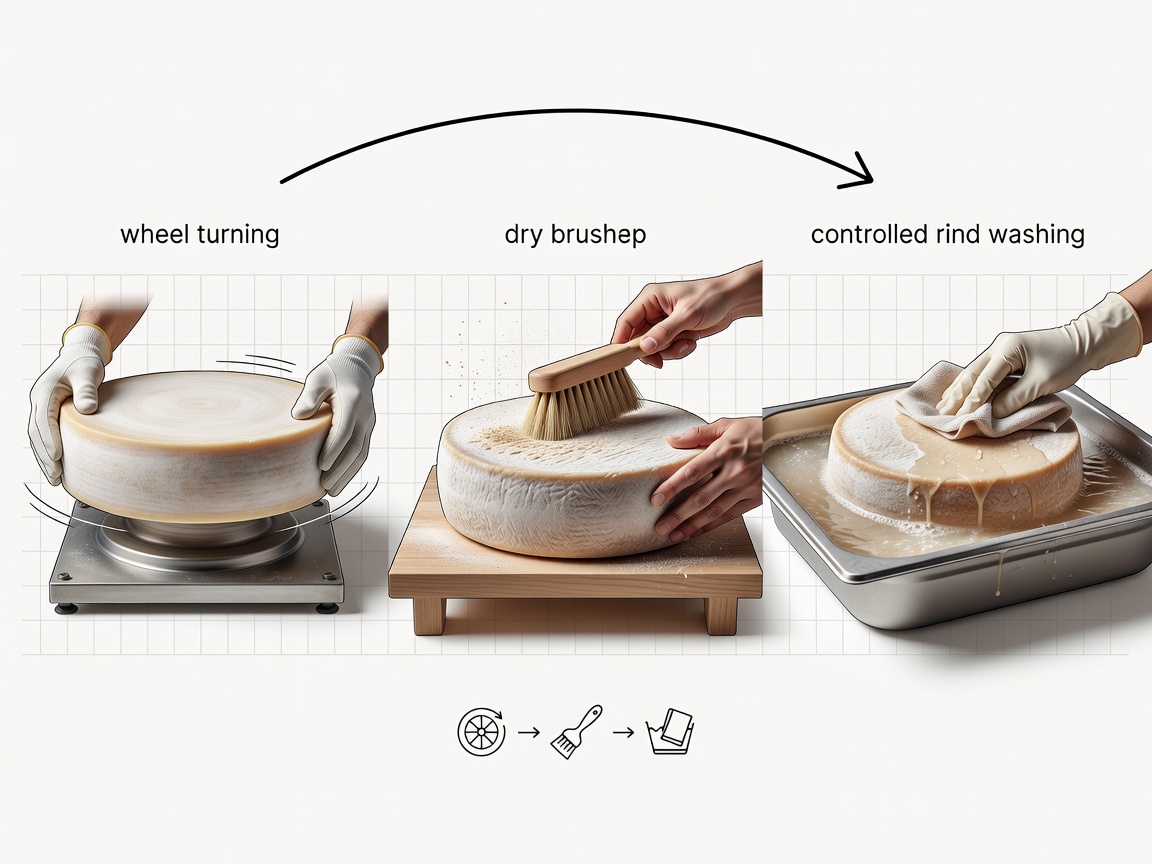
A care sequence, not a recipe
- Observe. Read the wheel and its surroundings before choosing an action.
- Handle. Turn or reposition only according to the cheese's established care system.
- Tend. Brush or wash where the style and producer's process require it.
- Record. Connect what was seen with what was done.
Why turning matters
Turning helps manage the way a wheel rests and the surfaces exposed to shelves and room air. It can support more even development and avoid leaving one face in the same contact position throughout maturation. Frequency depends on the cheese and its stage, as well as the producer's procedures. A daily schedule observed on one visit should not become advice for every cheese.
Handling also has a physical dimension. Large wheels require appropriate technique and sometimes equipment. Shelf height, aisle space and access influence the work. The practical elegance of a cellar lies partly in whether a skilled person can inspect and move a wheel safely, without treating care as a performance for the visitor.
Washing and brushing with purpose
In certain traditions, controlled rind washing helps establish or maintain a characteristic surface community. The liquid, tools and schedule belong to the producer's specific process. It is misleading to suggest that every alpine wheel is washed with the same brine, or that a strong-smelling surface proves a better cheese. Surface appearance and aroma must be interpreted within the intended style.
Brushing can manage surface growth and rind condition in other systems. It is not a general instruction to remove all visible mould. Some cheeses depend on particular surface development, while unexpected growth can require professional assessment. Household experiments based on a photograph of a cellar are not a substitute for appropriate food-safety guidance.
Knowing when a wheel is ready
Readiness involves the producer's specification, sensory assessment and intended market, not simply the longest possible maturation. Le Gruyère AOP, Beaufort and Comté provide useful examples of distinct regulated traditions; their official descriptions should be consulted for current requirements. Differences in age categories or care language should not be flattened into one mountain-cheese formula.
For the visitor, the most revealing question may be modest: “What changed in this wheel during its last stage here?” An answer about texture, moisture or rind condition gives craft a visible shape. Continue to the regional comparison for the places and institutions behind these practices.
Reference notebook
- Le Gruyère AOP — production and maturation.
- Beaufort's official cheese organisation — regional methods and specifications.
- Comté — making, affinage and tasting context.